Criminal defense in Rwanda - Friday, July 17, 2009  Via Houston attorney Mark Bennett's Defending People blog - which is very much worth a read, incidentally - I've found this piece from IBJ about Anita Mugeni, a criminal defense lawyer in Rwanda. Via Houston attorney Mark Bennett's Defending People blog - which is very much worth a read, incidentally - I've found this piece from IBJ about Anita Mugeni, a criminal defense lawyer in Rwanda.
Mugeni's a remarkable woman, having defended a neighbor who spent three years incarcerated while facing murder charges press by a prosecution system that hadn't done any investigation (even testing the alleged poison on an animal) and that knew the victim wasn't dead to begin with. But what I found really striking about the article was this: In June of 2009, Anita cooperated with International Bridges to Justice to train Rwandan lawyers in criminal defense law. Eighty of the three hundred lawyers in the country attended the training and discussed ways to expand the work that Anita and others are doing.Rwanda is a country of over 10 million people. There are 300 lawyers there. The United States is a country of 300 million people - there are 1.1 million lawyers here. That means that 1 in every 265 Americans is a lawyer. In Rwanda, that number is 1 in every 33,953. (Incidentally, those 300 lawyers represent a 600% increase from the post-genocide period in 1994. An article from last month on IBJ explains that "they are often the first ones to be eliminated when political instability, defiance, and conflict undermine the rule of law.") And, you know, it's just staggering to think about. Even if you've never hired a lawyer, and never expect that you're going to, in the US, if someone does you wrong, you're at least aware that there's some avenue for redress. But when there's only one lawyer for every thirty-thousand people with a problem, there's really no way to be empowered. That's not the focus of the article, though - when you've got someone as inspiring as Mugeni to write about, it'd better not be. The focus on the piece is legal aid in Rwanda, which is a pretty fascinating topic on its own.
 That's from a "Know Your Rights" poster, like the kind found all over Kigali and rural Rwanda. There's also a radio campaign - vital in countries like Rwanda - on the same subject, and training programs to make sure that all 300 of those lawyers are especially well-versed in criminal defense. That's from a "Know Your Rights" poster, like the kind found all over Kigali and rural Rwanda. There's also a radio campaign - vital in countries like Rwanda - on the same subject, and training programs to make sure that all 300 of those lawyers are especially well-versed in criminal defense. I won't end this with platitudes about how we should be grateful for our own system, flawed though it may be, or exhortions to give money to anyone - it's just useful sometimes to think about the things that we can afford to take for granted.
Labels: anita mugeni, developing world, know your rights, rwanda
posted by Dan
permalink
 
WHO DID YOU SEE? - Wednesday, July 15, 2009 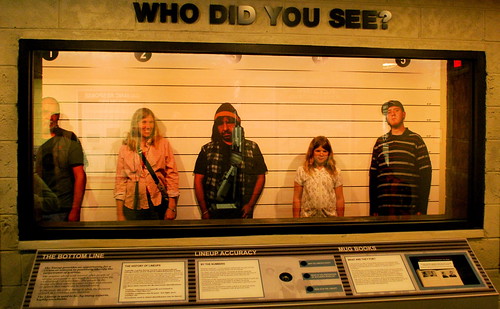 I couldn't agree with Kristi more. Governor Perry should sign the posthumous pardon for Timothy Cole and he should do so now. What is he waiting for? Is he afraid that such a pardon will make official the huge injustice perpetrated against Mr. Cole by the State of Texas? I couldn't agree with Kristi more. Governor Perry should sign the posthumous pardon for Timothy Cole and he should do so now. What is he waiting for? Is he afraid that such a pardon will make official the huge injustice perpetrated against Mr. Cole by the State of Texas?
Mr. Cole was convicted (it turns out, wrongly) and sentenced to 25 years in prison for the 1985 rape of Michelle Mallin. He said he was innocent and he said it time and again. But Ms. Mallin identified him in a photo lineup and then later identified him in a physical lineup. Her identification of Mr. Cole was "among the strongest evidence against [him] at trial," according to the foreman of the jury that convicted him. There has been extensive research and a lot written on the problems with eyewitness identifications, which are often unreliable, especially if made without certain safeguards. Lots of innocent people have been convicted based on bad eyewitness identifications. Eyewitness misidentification is the single greatest cause of wrongful convictions nationwide, playing a role in more than 75% of convictions overturned through DNA testing.While eyewitness testimony can be persuasive evidence before a judge or jury, 30 years of strong social science research has proven that eyewitness identification is often unreliable. Research shows that the human mind is not like a tape recorder; we neither record events exactly as we see them, nor recall them like a tape that has been rewound. Instead, witness memory is like any other evidence at a crime scene; it must be preserved carefully and retrieved methodically, or it can be contaminated. Here in Texas, there were attempts this past legislative session to reform eyewitness identification procedures to make them more reliable and to exclude from evidence identifications that were not made with specific lineup methods. Guess who was against such reform? Gov. Rick Perry vowed to veto any bill that applied laws on evidence exclusion to eyewitness identifications, said Keith Hampton, legislative director of the Texas Criminal Defense Lawyers. Apparently, Governor Perry. Timothy Cole died in prison in 1999. He died serving time for a crime he did not commit--as DNA evidence and the real perpetrator's confession later showed. Maybe Governor Perry doesn't want to sign Mr. Cole's posthumous pardon because he can't reconcile what happened to Mr. Cole with his position against reforms that could help stop the same thing from happening to other innocent Texans.
posted by Raman Gill
permalink
"Unthinking respect for authority is the greatest enemy of truth." -- Albert Einstein - Wednesday, July 15, 2009 Just as I had predicted, the public intoxication charges against Mindy Montford were dismissed this week. "It started last June when police pulled over her friend for allegedly driving drunk and the exchange was caught on an officer's dash cam.“My friend is an attorney," the driver said. Then the officer says "Ma'am, ma'am, ma'am -- I’m advising you to go back to the car.”
After seeing this type of abuse of power on many occasions, it is not surprising to see an officer make a wrongful arrest simply because his authority is being questioned, or because someone flunks the "attitude test". However, as I previously mentioned, what makes Mindy's arrest especially offensive and egregious to me is that it was done in retaliation after she was asked by her friend to provide legal advice. I don't mean to over-dramatize this unfortunate incident, but as I watched the video of the officer trying to silence Mindy, I couldn't help but think of the universal struggle between rule of law and a police state. The hallmark of totalitarian regimes is absolute control and an immediate silencing of anyone who dares to question authority. Criminal defense lawyers, who act as one of the only checks on police power, are society's best defense against a police state. As Justice Stevens once eloquently stated "the function of the independent lawyer . . . is a guardian of our freedom."
But this is not the end of the story for Mindy Montford. She’s filing a complaint with the city's Office of Police Monitor. Montford says it’s her duty to make sure no citizen goes through what she calls a “wrongful arrest”. Good, I'm glad that Mindy has the courage to take this one step further and pursue what is clearly an abuse of power. Because just like any other public servant, police officers must be held accountable. Plus, if someone like Mindy doesn't do this then who will? We all know that this kind of thing happens routinely to the powerless who never will make it on the news and who never will complain.
As criminal defense lawyers, we all have a duty to stand up for people and call out abuses of power when we see them. Labels: abuse of power, APD, mindy montford, the role of defense attorneys
posted by Kristin Etter
permalink
Teaching dogs to count, bullfight, and testify in court - Tuesday, July 14, 2009  That picture over there has been my desktop background on my computer here in the office for months. It’s easy to see why, really. I mean, Rex the Wonder Dog is a pretty remarkable creature, rescuing stagecoaches whose drivers have fallen ill and all. (Not to mention fighting bulls – as in bullfighting – and saving airplanes from crashing.) I found it while I was doing some research on police dog experts, and stumbled upon this site, which is a – how you say – passionate take on the issue. The caption for the image was "America needs Rex the Wonder Dog, not Adolf the Nazi Dog”, and, okay, that might have been my Google chat status for a few weeks, too, given that it’s one of the three greatest sentences ever formed in the English language. That picture over there has been my desktop background on my computer here in the office for months. It’s easy to see why, really. I mean, Rex the Wonder Dog is a pretty remarkable creature, rescuing stagecoaches whose drivers have fallen ill and all. (Not to mention fighting bulls – as in bullfighting – and saving airplanes from crashing.) I found it while I was doing some research on police dog experts, and stumbled upon this site, which is a – how you say – passionate take on the issue. The caption for the image was "America needs Rex the Wonder Dog, not Adolf the Nazi Dog”, and, okay, that might have been my Google chat status for a few weeks, too, given that it’s one of the three greatest sentences ever formed in the English language.
Anyway, on the subject of police dogs – There’s a really interesting post about “scent lineups”, where a dog testifies in court, essentially, by picking the scent of the culprit out of a group of five, over on Grits for Breakfast. This actually happens in South Texas, apparently quite often – Grits cites the Fort Bend County sheriff’s deputy who personally administers things as claiming to have used scent lineups in over 2,000 cases, which is just staggering. Because, well – I have a dog. Before he goes out, in order to calm him down once the door’s open and he’s wearing the leash, rarin’ to go for a walk, I make him sit and then I count to five. Sure enough, he sits patiently for one-two-three-four, and then as five nears his ears perk up and he gets ready to go, and when the word five escapes my lips, he takes his first steps out the door. I’m a rational person, and I’m not so delusional about my dog-whispering skills to believe that I’ve actually taught my dog math. I can recognize that my body language changes as I gear up to go out the door as I near five. The leash tenses, my stance changes slightly, my weight shifts to the foot I’ll be leading with, and it’s a dog’s job to be aware of these things. By the time I hit five, he’s aware that, based on subtle changes in the way I’m holding my body, something is happening.
Now imagine that a dog’s leash is being held as he’s being asked to respond to a certain scent. The deputy holding the leash has his own opinions on the guilt of the person being identified in the “lineup”, and when the dog reaches the correct scent, it seems just as likely that his body language is liable to shift and provide cues for the dog as mine is during the wait-and-count-to-five scene before going out for a walk. It’s hard not to think that, if this counts as evidence that’s held up in court, I’ve got a pretty strong case to make that I’ve taught my dog to count. Labels: dogs, evidence, lineups, rex the wonder dog
posted by Dan
permalink
The S&G Social Work Wish List - Monday, July 13, 2009 Being a Social Worker in a private, criminal defense law firm presents a unique set of difficulties. Quite often, we serve clients who aren’t poor but are nowhere even close to rich. This is a very difficult position to be in when you practice holistic advocacy – a model in which we try to identify the needs of our clients (and assist them in addressing those needs) in order to adequately and appropriately resolve the current charges and to prevent any future incidences.  It’s very similar to the problems that face the working poor. The working poor make just enough money to not be considered impoverished - a status which would give them access to local, state, and federal assistance - but not enough money to thrive on, or even survive, for that matter. In our case, our clients may make enough money to afford an attorney but accessing services beyond that is nearly impossible. Primarily, they don’t qualify for many services because they aren’t “poor”. Our clients rarely have great (if any) insurance that will cover services. And even if they did, many of the services they require wouldn’t be covered by insurance – DWI classes, anger management, impact panels, alcohol awareness, etc. They certainly can’t afford to pay out of pocket for services like therapy or addiction treatment. It’s very similar to the problems that face the working poor. The working poor make just enough money to not be considered impoverished - a status which would give them access to local, state, and federal assistance - but not enough money to thrive on, or even survive, for that matter. In our case, our clients may make enough money to afford an attorney but accessing services beyond that is nearly impossible. Primarily, they don’t qualify for many services because they aren’t “poor”. Our clients rarely have great (if any) insurance that will cover services. And even if they did, many of the services they require wouldn’t be covered by insurance – DWI classes, anger management, impact panels, alcohol awareness, etc. They certainly can’t afford to pay out of pocket for services like therapy or addiction treatment.
So, here’s my wish list that would make serving and supporting our clients so much easier: - I wish society stopped looking at people who commit crimes as low lifes, throwaways, undeserving, or any other title which alludes to a second (or third or fourth) class citizen. We are talking about people who fall into one of two categories: 1) People who have made a mistake or 2) People who have needs (often serious) that are not being met. That’s it. In my time working in a criminal defense law firm, I have not met one “bad” person. I have not met one sociopath. They are the rarest of the rare in the criminal world and, yet, society treats all people who enter the system as such. This simple change in perspective alone would facilitate my next two wishes:
- I wish the criminal justice decision makers would stop, halt, and desist in spending even one more penny on institutions of incarceration. Instead, I would like them to begin funding programs and services which will address issues that lead to criminal behaviors that are available to all people (rich or poor).
- I wish every person in America had healthcare that would adequately pay for all services related to health and well-being. Personally, I think the criminal justice system should pick up some of that ticket. They would save money on the back end by a long shot. Happy, healthy people rarely need to be prosecuted or convicted and certainly not incarcerated. Cha-ching, Mr. Attorney General.
Here’s to wishing…
posted by Athan
permalink
To Kill a Mockingbird and Posthumous Pardons - Friday, July 10, 2009  Earlier this week, I was talking with Kristin about To Kill a Mockingbird. (It recently played at the Paramount Theatre's Summer Film Series.) I remarked to her that every time I read the book or watch the movie, I find myself truly hoping and thinking that maybe this time Atticus Finch will win the trial and Tom Robinson will go free, even though I already know the ending. Earlier this week, I was talking with Kristin about To Kill a Mockingbird. (It recently played at the Paramount Theatre's Summer Film Series.) I remarked to her that every time I read the book or watch the movie, I find myself truly hoping and thinking that maybe this time Atticus Finch will win the trial and Tom Robinson will go free, even though I already know the ending.
I then pondered out loud whether Finch and Robinson would prevail in this day and age in our home state. Have we made that much progress? Somehow our conversation wandered into a discussion about Timothy Cole, who died in prison after being wrongly convicted of raping a Texas Tech student, and was later exonerated by Judge Charlie Baird after DNA testing proved that he was not the assailant.
Today I read in the Fort Worth Star-Telegram that the Texas Legislative Council issued a report showing that the Governor has the power to issue poshumous pardons and should do so for Mr. Cole.  Governor Perry has previously stated that an old AG's ruling dictates that in order to issue a posthumous pardon, he must first get authority from Texans through a constitutional amendment. This report now gives him the authority to do so without waiting for the passage of an amendment. As pointed out in an entry on Grits for Breakfast, the worst that could happen is that the courts could later say "no." No one with any standing to sue has threatened to do so, and I cannot dream up any reason for anyone to do so. Governor Perry has previously stated that an old AG's ruling dictates that in order to issue a posthumous pardon, he must first get authority from Texans through a constitutional amendment. This report now gives him the authority to do so without waiting for the passage of an amendment. As pointed out in an entry on Grits for Breakfast, the worst that could happen is that the courts could later say "no." No one with any standing to sue has threatened to do so, and I cannot dream up any reason for anyone to do so.
While unfortunately this will never bring Mr. Cole back to his family, it is Texas's chance to symbolically change the ending to To Kill a Mockingbird. Sign the pardon, Governor Perry! Labels: atticus finch, charlie baird, governor perry, grits for breakfast, posthumous pardons, timothy cole, to kill a mockingbird
posted by Kristi Couvillon
permalink
The "Seinfeld Session" - Friday, July 10, 2009  The 81st Texas Legislative Session was so unproductive that it has been dubbed by many as "the Seinfeld Session" - the session about nothing. However, just because there was little accomplished and taxpayers' money went largely down the drain does not mean that there was no damage. The 81st Texas Legislative Session was so unproductive that it has been dubbed by many as "the Seinfeld Session" - the session about nothing. However, just because there was little accomplished and taxpayers' money went largely down the drain does not mean that there was no damage.
Unfortunately, even in a Seinfeld Session, we still can't escape the insatiable legislative urge to rack up a few penalty enhancements and create a few new crimes. And since ignorance of the law excuses no one, I thought I would post the criminal justice highlights of the 2009 Legislative session: The Good
SB 839: Abolishes Life Without Parole for Juveniles
Amends § 12.31, Penal Code, Capital Felony, to provide that a juvenile convicted of a capital felony that was certified as an adult pursuant to § 54.02, Family Code, will be sentenced to life, not life without parole. Amends § 508.145, Government Code, Eligibility for Release on Parole; Computation of Parole Eligibility Date, to provide that a juvenile convicted of a capital felony that was certified as an adult pursuant to § 54.02 is not eligible for release on parole until the actual calendar time the inmate has served, without consideration of good conduct time, equals 40 calendar years. SB 1940: Authorizes Pretrial Diversion Program for Veterans
Adds Chapter 617, to Subtitle E, Title 7, Health and Safety Code, Veterans Court Program Defined; Procedures for Certain Defendants, to provide the commissioners court the authority to establish a veterans deferred prosecution program whereby if a veteran successfully completes a veterans court program, the court shall dismiss the case. SB 1681: Requires Corroboration of a Jailhouse Informant
Adds Article 38.075, Code of Criminal Procedure, Corroboration of Certain Testimony Required, to require corroboration before a person can be convicted on the testimony of a jailhouse informant. Provides that corroboration is not sufficient if it only shows that the offense was committed. HB 1736: Increases Payments and Services to Wrongfully Imprisoned
Adds § 103.052, Civil Practice and Remedies Code, Lump-Sum Compensation, to allow lump-sum compensation of $80,000 per each year of wrongful imprisonment and $25,000 per each year served on parole or as a registered sex offender. HB 2730: Requires DPS To Waive Surcharges for Indigent Amends § 708.158, Transportation Code, Indigent Status and Reduction of Surcharges, to state that DPS shall waive all driver’s license surcharges for a person who is indigent. - A person may submit the following to establish indigency: most recent federal income tax return or wages reflecting the person’s household income does not exceed 125 percent of the federal poverty guidelines or documentation that the person is receiving governmental assistance.
The Bad
SB 328: Expands Police Power for Mandatory Warrantless Blood Tests Amends § 724.017, Transportation Code, Blood Specimen, to expand mandatory warrantless blood draws if a person is arrested for an offense under Chapter 49 of the Penal Code involving the operation of a motor vehicle or watercraft and the person refuses the officer’s request to submit to the taking of the specimen voluntarily and:
- an individual other than the person has suffered bodily injury and was transported to a hospital or other medical facility for medical treatment;
- person is under arrest for DWI with child passenger under 15;
- the person has been previously convicted of DWI two or more times; or
- the person has been previously convicted of DWI with child passenger under 15, intoxication assault, or intoxication manslaughter;
HB 2086: Creates New First Degree Felony Crime of Directing Activities of Criminal Street Gangs and Creates Definition for Gang-Free Zone and Provides Penalty Enhancements Adds § 71.023, Penal Code, Directing Activities of Certain Gangs, to create the new crime of directing activities of certain criminal street gangs which is a first degree felony. Adds § 71.028, Penal Code, Gang-Free Zones, to establish gang-free zones and to increase penalty category to the next higher category (except for first-degree felonies) if it is shown that the actor is 17 years or older and commits a crime in a gang-free zone; specifically, if the offense was committed:
- Within 1000 feet of any school, higher education institution, youth center, or playground; or
- Within 300 feet of any shopping mall, movie theater, public swimming pool, video arcade; or
- On a school bus
HB 2240: Creates New Offense of Continual Violence Against the Family
Adds § 25.11, Penal Code, Continuous Violence Against the Family, to create a new offense of continual violence against the family, a third degree felony, if during a 12 month period, a person commits family violence two or more times. The Ugly HB 2846: Increases Age of Child Victims for Outcry Statement to 14 and Expands Outcry Statements to Include Acts Other Than the Alleged Offense that Were Committed Against the Child Victim or Other Victim Under 14 Amends § 1, Article 38.072, Code of Criminal Procedure, Hearsay Statement of Child Abuse Victim, to increase the age of a child victim from 12 to 14 for purposes of admitting an outcry statement and to allow outcry statements for criminal attempt of certain offenses.
Amends §2, Article 38.072, Code of Criminal Procedure, Hearsay Statement of Child Abuse Victim, to allow outcry statement of child victim under 14 concerning other crimes, wrongs, or acts other than the alleged offense and allegedly committed by the defendant against the victim or another child younger than 14. SB 727: Requires Judges to Order DNA Sample Collection for Defendants Granted Probation for a Felony and Juveniles Adjudicated of 3g Offenses Amends Article 102.020, Code of Criminal Procedure, Costs on Conviction for Offenses Requiring DNA Testing, to require a person placed on community supervision to pay $34 if DNA sample required.
Adds § 54.0409, Family Code, DNA Sample Required on Certain Felony Adjudications, to require the court to, on adjudication of a 3g felony or felony involving a deadly weapon, collect DNA, as a condition of probation, from a juvenile.
Adds Subsection J, § 11, Article 42.12, Code of Criminal Procedure, Community Supervision, to require a judge granting probation to a defendant convicted of a felony to require defendant to provide a DNA sample. Click here for our full 2009 Legislative Summary of new criminal justice laws. Labels: blood draws, dwi, juveniles, pretrial diversion, texas legislature
posted by Kristin Etter
permalink
A little bit of opium on the gums - Wednesday, July 08, 2009 More than a decade ago, one of my dearest friends decided to take her two and a half year old son to Sea World in San Antonio, which is where my parents live. She also had her second-born son with her, who was only six or so months old. My friend and I went to high school together and so my parents know her very well and, since I was spending the weekend with my parents, she and the boys came over for dinner after Sea World.
 While at my parents' home, the baby started crying - a lot. We were all trying different things to soothe him and nothing seemed to work. This is when my Dad, who did all the bread-winning and very little of the child-rearing in our family, suggested that what the baby needed to calm down was just a little bit of opium applied to his gums. This sent me and my friend into hysterical laughter - both the advice and the source of it seemed so preposterously funny. While at my parents' home, the baby started crying - a lot. We were all trying different things to soothe him and nothing seemed to work. This is when my Dad, who did all the bread-winning and very little of the child-rearing in our family, suggested that what the baby needed to calm down was just a little bit of opium applied to his gums. This sent me and my friend into hysterical laughter - both the advice and the source of it seemed so preposterously funny.
I couldn't help remembering this story after reading a recent Wall Street Journal article about the increasingly effective use of cultural defenses. In short, the idea is that someone's culture can be used to defend them against allegations they have committed a crime:
In 2004, Yer Vang, a member of the Hmong ethnic group who emigrated to the U.S. from Laos, was charged with opium trafficking after police found more than 300 grams of the substance in his Rock Hill, S.C., home. His lawyer presented evidence that that amount of opium was less than an average Hmong tribesman from his country smokes in a year."It's their version of Advil. They've been using this for 1,000 years," says Mr. Vang's lawyer, Chris Wellborn, argued.It worked. "An all-white, predominantly Republican, South Carolina jury found him not guilty," Mr. Wellborn said. My parents were both born and raised in India, and while they were growing up, opium was used regularly as a substance that soothed and killed pain; or, at least, this is what my Dad told us after we had calmed down from our laughing fit. And now that my husband and I have kids and I have clenched my teeth through many a 2-year old temper tantrum, I'm beginning to wonder if he might have been on to something. Detractors of cultural defenses posit that immigrants shouldn't get a break just because they were raised in a different culture, with different norms. To do so, they suggest, would be unfair to other citizens raised in this culture who are expected to abide by the law, no exceptions. I don't get that. Part of the job of a prosecutor, it seems, is to figure out if a person deserves a second chance; for example, probation versus jail time, or a dismissal versus a conviction that stays on a person's criminal record forever. And part of figuring that out is determining if they are dealing with a person who, while having done something criminal, is not really a criminal. Maybe they did something stupid because of their age. Or maybe they did something totally out of character because they were very intoxicated or under an enormous amount of stress. Maybe they have an undiagnosed mental health issue. Maybe they made on honest mistake. Or maybe they just didn't get it or get the seriousness of it--because of their cultural background. Of course, prosecutors have to consider whether the alleged crime was violent, whether there was a victim, or whether others were put in danger because of the defendant's behavior. Our practice is full of clients who broke the law, but have no criminal records, did not hurt anyone in the process, and have a number of mitigating factors that should be considered before a criminal conviction is put on their record, making it that much more difficult for them to get a job, obtain housing, or otherwise remain or become contributing members of our community. And it's our job as defense attorneys to make sure we put it all together for the prosecutor--to show them why a particular client deserves a second chance. We also need to educate that client along the way, and then show the prosecutor how the client has learned from the experience. It's our job to convince the prosecutor that our client won't make the same mistake again.
posted by Raman Gill
permalink
Picking the Low-Hanging Fruit - Wednesday, July 08, 2009 Here’s a fairly ridiculous example of an ill-conceived plan: TUCSON, Ariz. — A plan by the Pima County Sheriff's Department that would have stationed deputies at fast-food joints to sniff out drunken drivers appears to have fallen flat. The department had hoped to target drunken driving by putting undercover deputies inside 24-hour fast-food restaurants to spot impaired drivers placing their orders. If deputies spotted someone with classic symptoms of impairment, they were to call a uniformed deputy stationed outside to pull the driver over. But sheriff's Lt. Karl Woolridge says the department asked various fast-food chains if they'd agree to be a part of the program, but all of them declined.
Asking fast food drive-thru operators if they’d be willing to let the police hang out by the window in the middle of the night to  arrest only the customers who appear to be under the influence of some sort of substance is like asking head shop owners if they’d be willing to let the police in to bust only the customers who aren’t actually going to observe the tobacco use only signs posted throughout the place. If they did it, they’d have no customers at all. arrest only the customers who appear to be under the influence of some sort of substance is like asking head shop owners if they’d be willing to let the police in to bust only the customers who aren’t actually going to observe the tobacco use only signs posted throughout the place. If they did it, they’d have no customers at all. Anyway, what’s really silly about this is that it’s not the sort of thing that’ll have any impact on drunk driving. It’ll just have an impact on what drunk drivers eat. The odds of someone saying, “I know I really want a Carl’s Jr. burger at two-thirty this morning, I’d better not drink tonight” are pretty small. All a program like this would really accomplish would be to tell drunk drivers that the odds of getting stopped for DWI have just shrunk if they steer clear of the local Taco Bell. Thankfully, old-fashioned economics from the restaurateurs (if you can call someone who runs an A&W that) nixed this one. Labels: crime prevention, dwi
posted by Dan
permalink
Keep the Cameras Rolling! - Friday, July 03, 2009 I read last week in the Statesman that APD officials are reviewing their patrol car camera policies in regards to when officers must turn on their devices. The paper claimed that the new policies will likely require officers to film any incident in which they detain or try to stop a suspect, and will also likely require backup officers to also record incidents.  Police officials are also reviewing whether an officer's failure to follow the policy should fall under disciplinary guidelines. (As an aside, I have never handled a DWI case on either side of the bench where an officer forgot to turn on his or her camera to record a person walking the imaginary line.) Police officials are also reviewing whether an officer's failure to follow the policy should fall under disciplinary guidelines. (As an aside, I have never handled a DWI case on either side of the bench where an officer forgot to turn on his or her camera to record a person walking the imaginary line.)
This policy review comes after the fatal shooting of Nathaniel Sanders II by Senior Police Officer Leonardo Quintana, whose camera was not recording when he fired at Sanders. If I were an officer who found myself in a deadly situation and believed my actions were justified, I would definitely want that recorded as the video would serve to protect and exonerate me. And, if the shooting was not justified, Mr. Sanders' family and the rest of our community deserves to be told the truth. I commend the APD top brass for reviewing these policies and hope that they do implement policy that requires all potential stops and detentions to be recorded. Even better, I would like to see the cameras automatically activated as soon as their overhead lights or sirens are turned on or as soon as they respond to a dispatch. Or a type of rotating digital loop like security cameras use in which the camera is constantly recording. Surely we're technologically capable of that.
Labels: abuse of power, APD, cameras, leonardo quintana, nathaniel sanders II, police violence, policy, recording
posted by Kristi Couvillon
permalink
Why You'll Probably Fail Field Sobriety Tests While Totally Sober - Friday, July 03, 2009 By Raman Gill Former Texas House speaker Gib Lewis had this to say about his recent DWI arrest: "There's nothing to say but don't drink and drive." Former Texas House speaker Gib Lewis had this to say about his recent DWI arrest: "There's nothing to say but don't drink and drive."
That's excellent advice and it's exactly what I tell my family and friends, as well as my clients who are charged with DWI. And by "Don't drink and drive," I don't mean, "Be sure you only have one or two drinks, no more, before you drive," or, "Be sure you wait a good while after having a drink before you get behind the wheel." Nope. I mean, don't drink ANY alcoholic beverage and then drive (or boat, which seems particularly relevant given these three-digit temperatures and the need we all seem to feel to be in or around water if outside these days).
I can't tell you how many people our firm has represented who've had a drink or two after work, or two glasses of wine at a book club meeting, or a glass or two of wine at dinner with their spouse, and then were stopped for a minor traffic violation while driving home - and the next thing they knew they were trying to take nine steps, heel-to-toe, down an imaginary line along the side of a dark road. Often, when an officer smells ANY alcohol on your breath, he'll start asking you about whether you've been drinking and then he'll ask you if you mind taking a few field sobriety tests.
The answer to the officer's question, by the way, is YES, you do mind. You mind very much. (Except you say it very politely, as in, "With all due respect officer, I won't take any field sobriety tests and I'd like to speak with my lawyer.") Because unless you've got the balancing skills of Mary Lou Retton (I know this reference ages me, but I remember her landing perfectly off that vault in the 1984 Olympics to win the all-around women's gold medal), you might very well fail these tests, intoxicated or not.
I'm certified to administer the three "standardized" field sobriety tests most often given during DWI stops, as are most lawyers at our firm. Part of our training included attempting these tests - many times. I certainly don't want to impugn the balancing abilities of my colleagues, but let me at least say as to myself - I could not do the "Walk and Turn" or "One Leg Stand" stone cold sober, at least not until I practiced many, many times. It's simply not natural to walk heel-to-toe with your hands by your side, or with one leg six inches off the ground. If you've ever tried yoga, you'll know that making your body do what it doesn't do in everyday life doesn't always go so well the first few times. Especially if you're very nervous and distracted, maybe on the side of the highway, as most people are during DWI stops. Even our resident yoga diva Kristin Etter gave a less-than-stellar performance her first few goes at these field sobriety tests. (Did I say I wasn't going to impugn anyone else's balancing skills? Sorry, Kristin!)
So there you have it. One of the many reasons it's really just better to not drink and drive - at all. Labels: dwi, field sobriety tests, gib lewis
posted by Dan
permalink
Only in Texas - Wednesday, July 01, 2009  Imagine being told that you must register as a sex offender for life for something that is not a even a crime in Texas, let alone a registerable offense. Well, that is exactly what happened to a client of mine when he moved from out-of-state to Texas to live near his mother. When I consulted with this young man I thought surely this is a beaurocratic mix-up with Texas Department of Public Safety that can be resolved with a few phone calls right? Wrong. What ensued was a series of Kafka-esque conversations with DPS employees, culminating in a year of litigation after we had to sue DPS to have our client removed from the sex offender registry. Imagine being told that you must register as a sex offender for life for something that is not a even a crime in Texas, let alone a registerable offense. Well, that is exactly what happened to a client of mine when he moved from out-of-state to Texas to live near his mother. When I consulted with this young man I thought surely this is a beaurocratic mix-up with Texas Department of Public Safety that can be resolved with a few phone calls right? Wrong. What ensued was a series of Kafka-esque conversations with DPS employees, culminating in a year of litigation after we had to sue DPS to have our client removed from the sex offender registry.
The situation all started when my client was convicted of a misdemeanor in his home state for having consensual sex with his seventeen year old girlfriend when he was twenty-one (the longer back story was that the girlfriend's father was upset so he called the cops to report this "crime"). Unlike Texas, where the age of consent is seventeen, in my client's homestate, the age of consent was eighteen. When he moved to Texas, however, authorities told him that because his "offense" was "substantially similar" (more on that in a second) to the Texas offense of Sexual Assault of a Child, he would have to register as a sex offender for life. Despite the fact that courts have held that sex offender registration is a "collateral consequence," and "non-punitive", having to register as a sex offender is as close as you can get to a lifetime sentence if you ask me.
The legal basis DPS was relying on to make my client register was a provision under Article 62.003 of the Code of Criminal Procedure which allows DPS to make a determination whether an out-of-state offense is "substantially similar" to an offense here in Texas. If they say yes, then you will be forced, with threat of prosecution for the third-degree felony of failure to register as a sex offender, for the rest of your life. Thankfully, 62.003 also contains a provision that allows a person to appeal this determination by DPS. As I mentioned, this is exactly what we had to do in this case.
The result? The Court thankfully sided with us and found that my client's previous offense was not "substantially similar" to any offense in Texas (imagine that, something that is not a crime in Texas is not "substantially similar" to a crime in Texas). Moreover, the Court ordered DPS to immediately remove my client from the sex offender registry and to contact all agencies that they have previously disseminated this information to.
Interestingly, in some logistical discussions with DPS post-hearing, I was told that this was the first case ever brought successfully in Texas under 62.003. What this tells me anecdotally is that my client can't be the only one in this situation. If I had to guess, I would suspect that there must be hundreds, if not thousands, of people in Texas who are currently on the sex offender registry that should not be.
Labels: dps, public perception, sex offender registration
posted by Kristin Etter
permalink
|