Criminal defense in Rwanda - Friday, July 17, 2009  Via Houston attorney Mark Bennett's Defending People blog - which is very much worth a read, incidentally - I've found this piece from IBJ about Anita Mugeni, a criminal defense lawyer in Rwanda. Via Houston attorney Mark Bennett's Defending People blog - which is very much worth a read, incidentally - I've found this piece from IBJ about Anita Mugeni, a criminal defense lawyer in Rwanda.
Mugeni's a remarkable woman, having defended a neighbor who spent three years incarcerated while facing murder charges press by a prosecution system that hadn't done any investigation (even testing the alleged poison on an animal) and that knew the victim wasn't dead to begin with. But what I found really striking about the article was this: In June of 2009, Anita cooperated with International Bridges to Justice to train Rwandan lawyers in criminal defense law. Eighty of the three hundred lawyers in the country attended the training and discussed ways to expand the work that Anita and others are doing.Rwanda is a country of over 10 million people. There are 300 lawyers there. The United States is a country of 300 million people - there are 1.1 million lawyers here. That means that 1 in every 265 Americans is a lawyer. In Rwanda, that number is 1 in every 33,953. (Incidentally, those 300 lawyers represent a 600% increase from the post-genocide period in 1994. An article from last month on IBJ explains that "they are often the first ones to be eliminated when political instability, defiance, and conflict undermine the rule of law.") And, you know, it's just staggering to think about. Even if you've never hired a lawyer, and never expect that you're going to, in the US, if someone does you wrong, you're at least aware that there's some avenue for redress. But when there's only one lawyer for every thirty-thousand people with a problem, there's really no way to be empowered. That's not the focus of the article, though - when you've got someone as inspiring as Mugeni to write about, it'd better not be. The focus on the piece is legal aid in Rwanda, which is a pretty fascinating topic on its own.
 That's from a "Know Your Rights" poster, like the kind found all over Kigali and rural Rwanda. There's also a radio campaign - vital in countries like Rwanda - on the same subject, and training programs to make sure that all 300 of those lawyers are especially well-versed in criminal defense. That's from a "Know Your Rights" poster, like the kind found all over Kigali and rural Rwanda. There's also a radio campaign - vital in countries like Rwanda - on the same subject, and training programs to make sure that all 300 of those lawyers are especially well-versed in criminal defense. I won't end this with platitudes about how we should be grateful for our own system, flawed though it may be, or exhortions to give money to anyone - it's just useful sometimes to think about the things that we can afford to take for granted.
Labels: anita mugeni, developing world, know your rights, rwanda
posted by Dan
permalink
 
WHO DID YOU SEE? - Wednesday, July 15, 2009 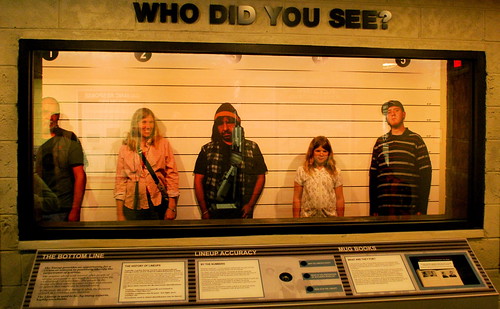 I couldn't agree with Kristi more. Governor Perry should sign the posthumous pardon for Timothy Cole and he should do so now. What is he waiting for? Is he afraid that such a pardon will make official the huge injustice perpetrated against Mr. Cole by the State of Texas? I couldn't agree with Kristi more. Governor Perry should sign the posthumous pardon for Timothy Cole and he should do so now. What is he waiting for? Is he afraid that such a pardon will make official the huge injustice perpetrated against Mr. Cole by the State of Texas?
Mr. Cole was convicted (it turns out, wrongly) and sentenced to 25 years in prison for the 1985 rape of Michelle Mallin. He said he was innocent and he said it time and again. But Ms. Mallin identified him in a photo lineup and then later identified him in a physical lineup. Her identification of Mr. Cole was "among the strongest evidence against [him] at trial," according to the foreman of the jury that convicted him. There has been extensive research and a lot written on the problems with eyewitness identifications, which are often unreliable, especially if made without certain safeguards. Lots of innocent people have been convicted based on bad eyewitness identifications. Eyewitness misidentification is the single greatest cause of wrongful convictions nationwide, playing a role in more than 75% of convictions overturned through DNA testing.While eyewitness testimony can be persuasive evidence before a judge or jury, 30 years of strong social science research has proven that eyewitness identification is often unreliable. Research shows that the human mind is not like a tape recorder; we neither record events exactly as we see them, nor recall them like a tape that has been rewound. Instead, witness memory is like any other evidence at a crime scene; it must be preserved carefully and retrieved methodically, or it can be contaminated. Here in Texas, there were attempts this past legislative session to reform eyewitness identification procedures to make them more reliable and to exclude from evidence identifications that were not made with specific lineup methods. Guess who was against such reform? Gov. Rick Perry vowed to veto any bill that applied laws on evidence exclusion to eyewitness identifications, said Keith Hampton, legislative director of the Texas Criminal Defense Lawyers. Apparently, Governor Perry. Timothy Cole died in prison in 1999. He died serving time for a crime he did not commit--as DNA evidence and the real perpetrator's confession later showed. Maybe Governor Perry doesn't want to sign Mr. Cole's posthumous pardon because he can't reconcile what happened to Mr. Cole with his position against reforms that could help stop the same thing from happening to other innocent Texans.
posted by Raman Gill
permalink
"Unthinking respect for authority is the greatest enemy of truth." -- Albert Einstein - Wednesday, July 15, 2009 Just as I had predicted, the public intoxication charges against Mindy Montford were dismissed this week. "It started last June when police pulled over her friend for allegedly driving drunk and the exchange was caught on an officer's dash cam.“My friend is an attorney," the driver said. Then the officer says "Ma'am, ma'am, ma'am -- I’m advising you to go back to the car.”
After seeing this type of abuse of power on many occasions, it is not surprising to see an officer make a wrongful arrest simply because his authority is being questioned, or because someone flunks the "attitude test". However, as I previously mentioned, what makes Mindy's arrest especially offensive and egregious to me is that it was done in retaliation after she was asked by her friend to provide legal advice. I don't mean to over-dramatize this unfortunate incident, but as I watched the video of the officer trying to silence Mindy, I couldn't help but think of the universal struggle between rule of law and a police state. The hallmark of totalitarian regimes is absolute control and an immediate silencing of anyone who dares to question authority. Criminal defense lawyers, who act as one of the only checks on police power, are society's best defense against a police state. As Justice Stevens once eloquently stated "the function of the independent lawyer . . . is a guardian of our freedom."
But this is not the end of the story for Mindy Montford. She’s filing a complaint with the city's Office of Police Monitor. Montford says it’s her duty to make sure no citizen goes through what she calls a “wrongful arrest”. Good, I'm glad that Mindy has the courage to take this one step further and pursue what is clearly an abuse of power. Because just like any other public servant, police officers must be held accountable. Plus, if someone like Mindy doesn't do this then who will? We all know that this kind of thing happens routinely to the powerless who never will make it on the news and who never will complain.
As criminal defense lawyers, we all have a duty to stand up for people and call out abuses of power when we see them. Labels: abuse of power, APD, mindy montford, the role of defense attorneys
posted by Kristin Etter
permalink
Teaching dogs to count, bullfight, and testify in court - Tuesday, July 14, 2009 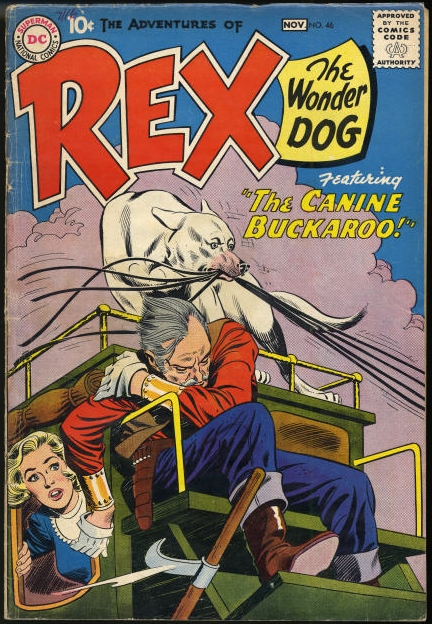 That picture over there has been my desktop background on my computer here in the office for months. It’s easy to see why, really. I mean, Rex the Wonder Dog is a pretty remarkable creature, rescuing stagecoaches whose drivers have fallen ill and all. (Not to mention fighting bulls – as in bullfighting – and saving airplanes from crashing.) I found it while I was doing some research on police dog experts, and stumbled upon this site, which is a – how you say – passionate take on the issue. The caption for the image was "America needs Rex the Wonder Dog, not Adolf the Nazi Dog”, and, okay, that might have been my Google chat status for a few weeks, too, given that it’s one of the three greatest sentences ever formed in the English language. That picture over there has been my desktop background on my computer here in the office for months. It’s easy to see why, really. I mean, Rex the Wonder Dog is a pretty remarkable creature, rescuing stagecoaches whose drivers have fallen ill and all. (Not to mention fighting bulls – as in bullfighting – and saving airplanes from crashing.) I found it while I was doing some research on police dog experts, and stumbled upon this site, which is a – how you say – passionate take on the issue. The caption for the image was "America needs Rex the Wonder Dog, not Adolf the Nazi Dog”, and, okay, that might have been my Google chat status for a few weeks, too, given that it’s one of the three greatest sentences ever formed in the English language.
Anyway, on the subject of police dogs – There’s a really interesting post about “scent lineups”, where a dog testifies in court, essentially, by picking the scent of the culprit out of a group of five, over on Grits for Breakfast. This actually happens in South Texas, apparently quite often – Grits cites the Fort Bend County sheriff’s deputy who personally administers things as claiming to have used scent lineups in over 2,000 cases, which is just staggering. Because, well – I have a dog. Before he goes out, in order to calm him down once the door’s open and he’s wearing the leash, rarin’ to go for a walk, I make him sit and then I count to five. Sure enough, he sits patiently for one-two-three-four, and then as five nears his ears perk up and he gets ready to go, and when the word five escapes my lips, he takes his first steps out the door. I’m a rational person, and I’m not so delusional about my dog-whispering skills to believe that I’ve actually taught my dog math. I can recognize that my body language changes as I gear up to go out the door as I near five. The leash tenses, my stance changes slightly, my weight shifts to the foot I’ll be leading with, and it’s a dog’s job to be aware of these things. By the time I hit five, he’s aware that, based on subtle changes in the way I’m holding my body, something is happening.
Now imagine that a dog’s leash is being held as he’s being asked to respond to a certain scent. The deputy holding the leash has his own opinions on the guilt of the person being identified in the “lineup”, and when the dog reaches the correct scent, it seems just as likely that his body language is liable to shift and provide cues for the dog as mine is during the wait-and-count-to-five scene before going out for a walk. It’s hard not to think that, if this counts as evidence that’s held up in court, I’ve got a pretty strong case to make that I’ve taught my dog to count. Labels: dogs, evidence, lineups, rex the wonder dog
posted by Dan
permalink
The S&G Social Work Wish List - Monday, July 13, 2009 Being a Social Worker in a private, criminal defense law firm presents a unique set of difficulties. Quite often, we serve clients who aren’t poor but are nowhere even close to rich. This is a very difficult position to be in when you practice holistic advocacy – a model in which we try to identify the needs of our clients (and assist them in addressing those needs) in order to adequately and appropriately resolve the current charges and to prevent any future incidences.  It’s very similar to the problems that face the working poor. The working poor make just enough money to not be considered impoverished - a status which would give them access to local, state, and federal assistance - but not enough money to thrive on, or even survive, for that matter. In our case, our clients may make enough money to afford an attorney but accessing services beyond that is nearly impossible. Primarily, they don’t qualify for many services because they aren’t “poor”. Our clients rarely have great (if any) insurance that will cover services. And even if they did, many of the services they require wouldn’t be covered by insurance – DWI classes, anger management, impact panels, alcohol awareness, etc. They certainly can’t afford to pay out of pocket for services like therapy or addiction treatment. It’s very similar to the problems that face the working poor. The working poor make just enough money to not be considered impoverished - a status which would give them access to local, state, and federal assistance - but not enough money to thrive on, or even survive, for that matter. In our case, our clients may make enough money to afford an attorney but accessing services beyond that is nearly impossible. Primarily, they don’t qualify for many services because they aren’t “poor”. Our clients rarely have great (if any) insurance that will cover services. And even if they did, many of the services they require wouldn’t be covered by insurance – DWI classes, anger management, impact panels, alcohol awareness, etc. They certainly can’t afford to pay out of pocket for services like therapy or addiction treatment.
So, here’s my wish list that would make serving and supporting our clients so much easier: - I wish society stopped looking at people who commit crimes as low lifes, throwaways, undeserving, or any other title which alludes to a second (or third or fourth) class citizen. We are talking about people who fall into one of two categories: 1) People who have made a mistake or 2) People who have needs (often serious) that are not being met. That’s it. In my time working in a criminal defense law firm, I have not met one “bad” person. I have not met one sociopath. They are the rarest of the rare in the criminal world and, yet, society treats all people who enter the system as such. This simple change in perspective alone would facilitate my next two wishes:
- I wish the criminal justice decision makers would stop, halt, and desist in spending even one more penny on institutions of incarceration. Instead, I would like them to begin funding programs and services which will address issues that lead to criminal behaviors that are available to all people (rich or poor).
- I wish every person in America had healthcare that would adequately pay for all services related to health and well-being. Personally, I think the criminal justice system should pick up some of that ticket. They would save money on the back end by a long shot. Happy, healthy people rarely need to be prosecuted or convicted and certainly not incarcerated. Cha-ching, Mr. Attorney General.
Here’s to wishing…
posted by Athan
permalink
|